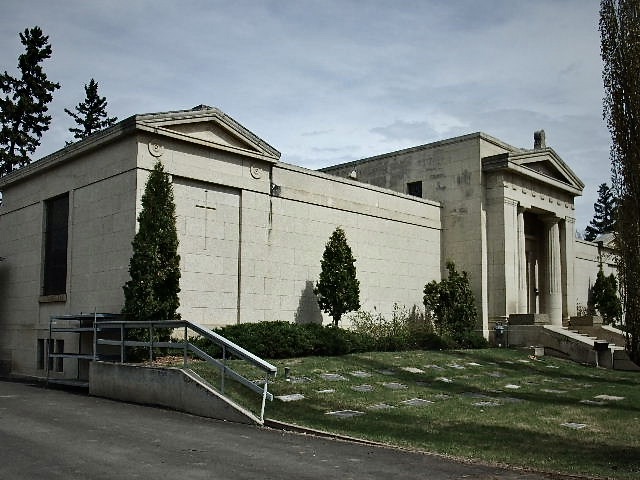
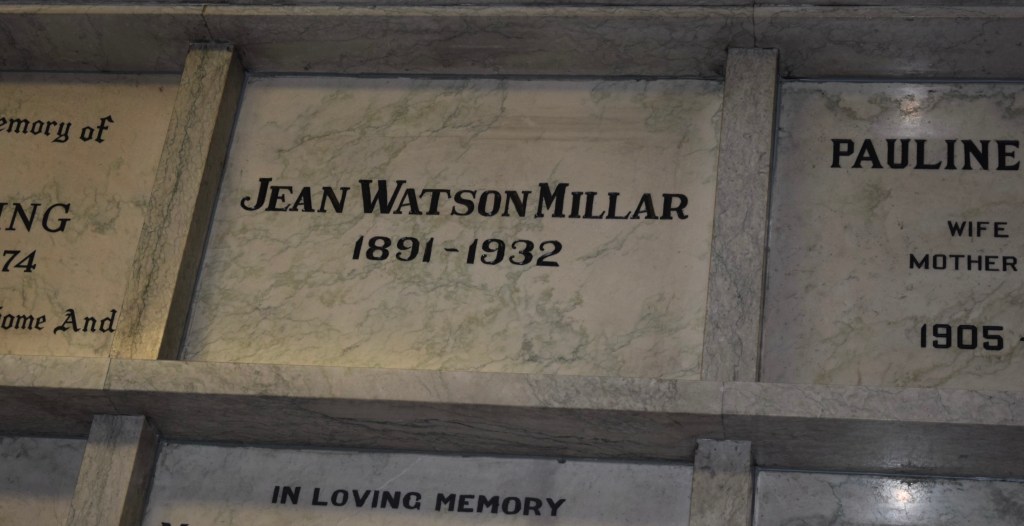
Down the pathways and lanes of the old Edmonton cemetery, the chill of the spring wind sideswipes all in its way and then announces a mausoleum on the western edge. Within the marble walls, are the familiar names of Alberta pioneers and are those found in the history books. Laid to rest surrounded by simplicity and elegance, the inscriptions on the headstones speak their stories. At a glance upwards, one name remains alone. Who is Jean Watson Millar? Is there not a pioneer story to tell?
Jean Watson Millar’s death occurred in a very historical time. The Great Depression of the early 1930s was a worldwide social and economic shock. Few countries were affected as severely as Canada. Millions of Canadians were left unemployed, hungry and often homeless. The decade became known as the Dirty Thirties due to a crippling drought in the Prairies, as well as Canada’s dependence on raw material and farm exports. Widespread losses of jobs and savings transformed the country.
Saskatchewan and Alberta had seen incredible growth in immigration from 1900 through the 1920s as settlers came to these provinces to establish farms. The area was known as the ‘Bread Basket’ of North America because of the success growing wheat and other grain crops. Prairie land was broken and native vegetation like prairie grasses and low shrubs were cleared from the land and farmers planted crops.
In these early years, farms were successful due to good growing conditions. As the 1930s began, however, the farmers experienced prolonged drought which caused repeated devastation to annual harvests. Farm losses were compounded by infestations of cutworms, sawflies, and grasshoppers.
Farmers struggled to maintain their farms and governments were slow to respond to the crisis. Banks began repossessing farms and other farms were abandoned. It has been suggested that nearly 750,000 farms were lost in Canada between 1930 and 1935 and a majority of them were in southeastern Alberta and southern Saskatchewan. The ‘Bread Basket’ came to be known as the ‘Dust Bowl’.
Families who left their farms appeared to choose three different types of relocation: move to Ontario or eastern United States; move to bigger urban centres such as Regina, Saskatoon, Calgary, or Edmonton; or move to the northern part of the provinces.
Was the story of Jean Watson Millar encompassed by the bereft of the world around her? What was the misfortune that took her young life?
Looking through Archives, the story begins to unravel.
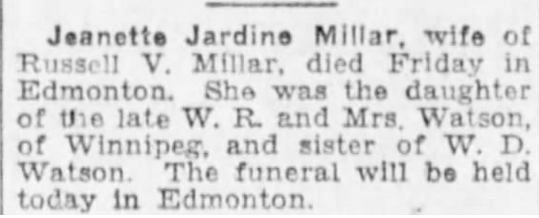
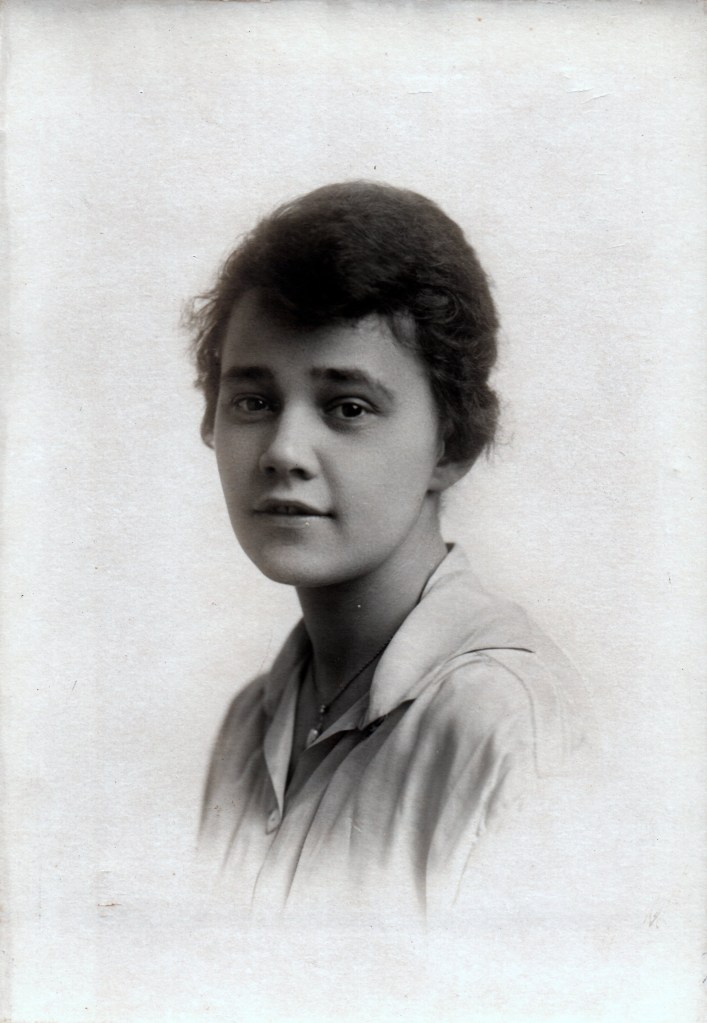
The story of Jeanette Jardine Watson Millar begins in Winnipeg, Manitoba. She was the daughter of 1890’s Winnipeg pioneers William Redpath Watson and Mary Linton Johnston. Her father was an accountant and the first real estate agent in Winnipeg, her mother a teacher. Their residence, Watson House on Balmoral Street, is a designated historical home. In addition to being the sister of William Douglas Watson, a lawyer and ‘Memorable Manitoban’, Jeanette was the second daughter of three, with Helen the eldest and Marjory the younger. She married Russell Vere Millar Oct 4, 1919 in Winnipeg and the young couple headed to their new home in Edmonton. The couple were blessed with two daughters, Mary Louise (1923) and Elizabeth Jean (1924). The family thrived. Sadly, Jeanette Jardine Watson Millar passed Friday, December 02, 1932. She suffered a stroke following the premature birth of a son on November 19 1932. He was buried with her, cradled in her arms.
While this young woman’s presence was so missed, her warm smile and gentle touch not forgotten. Russell successfully single-parented his two daughters. Although Scottish stern, the girls had only love and respect for him. Mary Lou and Betty were not only sisters but best friends. They lived their best lives that included husband, children, community contribution and careers. Jeanette and Russell’s son received a name – Russell James Watson Millar and when her family gathers, a hall needs to be hired as they number at least 100.
It is my joy to share this story. Jeanette Jardine Watson Millar is my maternal grandmother.
 Millar Watson Family Stories
Leave a comment